
Stamp Duty for Rental in Singapore: Rates, Deadlines, and the Steps After Paying


💡 TL;DR
Tap any row to jump to the details.
What it isA government tax on your tenancy agreement, paid to IRAS. It makes the agreement legally valid and usable as evidence in court.
The rate0.4% of the total rent for the whole lease period, for leases of four years or less. A SGD 2,500 monthly rent on a 12-month lease works out to SGD 120.
Who paysThe tenant, unless the tenancy agreement says otherwise.
Deadline14 days after signing in Singapore, or 30 days if the agreement was signed overseas. Late stamping penalties go up to 4 times the duty.
How to payOnline on the IRAS e-Stamping portal with Singpass, in about 10 minutes.
After payingSave the stamp certificate PDF. Your landlord, agent, or bank will ask for it later. Cove tenants can upload it in the Cove app.
What is stamp duty on a tenancy agreement?
Stamp duty is a government tax on your rental agreement in Singapore. You are paying tax on the document itself, not on the property, and the payment goes directly to the Inland Revenue Authority of Singapore (IRAS). It is not an agent fee, a security deposit, or a charge collected by your landlord.
The term "stamp duty" comes from the days when physical documents were stamped with ink as official proof that the tax was paid. Today, the process is digital, and your proof is a downloadable Stamp Certificate PDF. Official IRAS documentation refers to this specifically as lease duty.
Paying stamp duty is mandatory for two main reasons:
- It is a legal requirement for rental agreements in Singapore.
- An unstamped agreement cannot be used as evidence in court. If a dispute arises with your landlord (such as an unfair security deposit deduction), a stamped tenancy agreement is your primary protection. Paying stamp duty ensures your contract can actually protect you if needed.
This requirement applies whether you are renting a single room or an entire unit. It also applies whenever you renew or extend your lease, not just when signing a new contract.
How much stamp duty costs for a rental in Singapore
Calculating your stamp duty takes only a few seconds. The formula is:
For leases of four years or less. Rent includes maintenance, service and furniture charges, before GST.
Here is how that breaks down for common rental amounts:
When calculating total rent, IRAS includes base rent along with additional contractual charges like maintenance fees, service charges, and furniture fees, but excludes GST. If your agreement lists base rent and service fees separately, add them together before applying the 0.4% rate.
Two minor exceptions to keep in mind:
- For leases longer than four years, stamp duty is calculated at 0.4% of four times the average annual rent.
- Leases with an average annual rent of SGD 1,000 or below are exempt from stamp duty, though residential rents in Singapore rarely fall into this range.
Stamp Duty Calculator
Include maintenance, service and furniture charges, before GST.
Your stamp duty
SGD 120
SGD 2,500 x 12 months x 0.4% = SGD 120
Pay it within 14 days of signing your tenancy agreement, or 30 days if you signed it overseas.
That is on top of the SGD 120 duty you still have to pay. Paying on time is much cheaper.
Estimate for residential leases up to 4 years, based on IRAS rates as of August 2026. Official figure: IRAS e-Stamping portal.
The tenant pays stamp duty in most tenancy agreements
A common question among new renters is why the tenant is expected to pay this tax rather than the landlord.
First, market practice in Singapore assigns this payment to the tenant. Second, under IRAS rules, if a tenancy agreement is silent on who pays, the financial responsibility automatically falls on the tenant.
Before signing your agreement, check for a stamp duty clause. While who pays can technically be negotiated (some landlords may agree to cover it to finalize a deal quickly), you should assume you are paying unless your contract explicitly states otherwise.
The 14-day deadline and penalties for late stamping
Stamp duty must be paid promptly after signing your tenancy agreement:
- Signed in Singapore: Paid within 14 days of signing.
- Signed overseas: Paid within 30 days after the document is received in Singapore (common for expats arranging housing before relocating).
Missing the deadline incurs statutory late payment penalties:
- Late by up to 3 months: SGD 10 or an amount equal to the duty owed, whichever is higher.
- Late by more than 3 months: SGD 25 or 4 times the duty owed, whichever is higher.
For example, a standard SGD 120 stamp duty payment delayed by more than three months can result in a SGD 480 penalty. Completing the online process takes about 10 minutes and avoids these extra costs.
How to pay stamp duty on the IRAS e-Stamping portal
The whole process usually takes about 10 minutes.
What if I don't have a Singpass?
If you do not have a Singpass, you can still pay Stamp Duty by using the "Request for Stamping" service on the IRAS e-Stamping portal. This method allows you to submit your details manually without logging in with Singpass.
What to do with your stamp certificate after paying
Your Stamp Certificate PDF serves as your official proof of payment. Once issued, handle it as follows:
- Save the PDF securely: Retain a copy until your security deposit is returned at the end of your tenancy, as deposit disputes typically occur well after lease signing.
- Send a copy to your landlord or property agent: Landlords and agents require the certificate for their records. Proactively sharing it saves you from follow-up requests later.
- Keep it accessible for administrative tasks: A stamped tenancy agreement is a widely accepted proof of address in Singapore, frequently required when opening a local bank account or registering for local services.
Manage your stamp duty easily with the Cove app
If you're a Cove tenant, you can manage your stamp duty directly from Cove App. By integrating document management directly, it removed the friction of traditional paperwork.
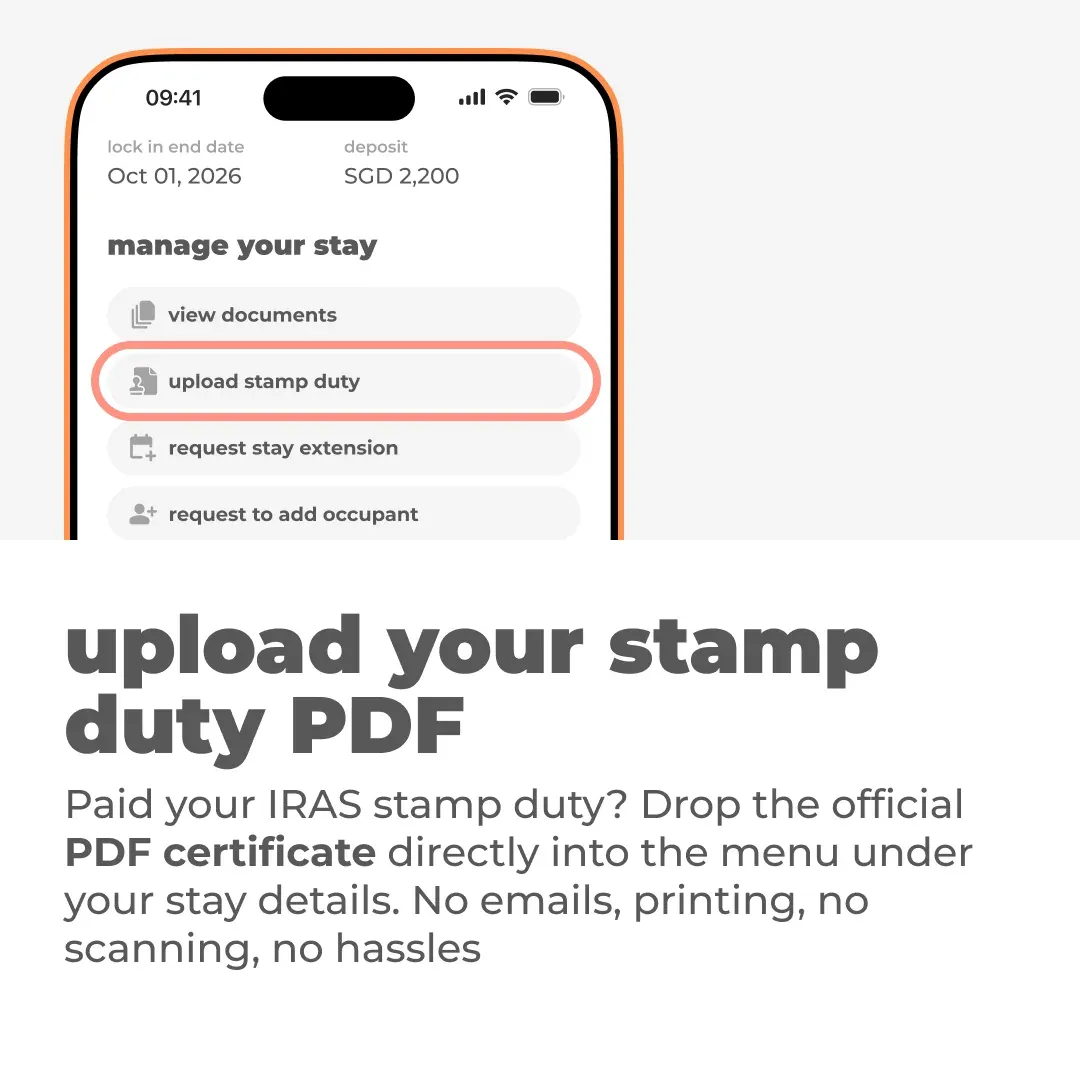
- Direct certificate upload: You can upload your stamp certificate PDF directly through the app by navigating to Stay Details > Manage Your Stay > Upload Stamp Duty. This streamlined feature ensures you never have to print, scan, or email your documents to your agent or landlord again.
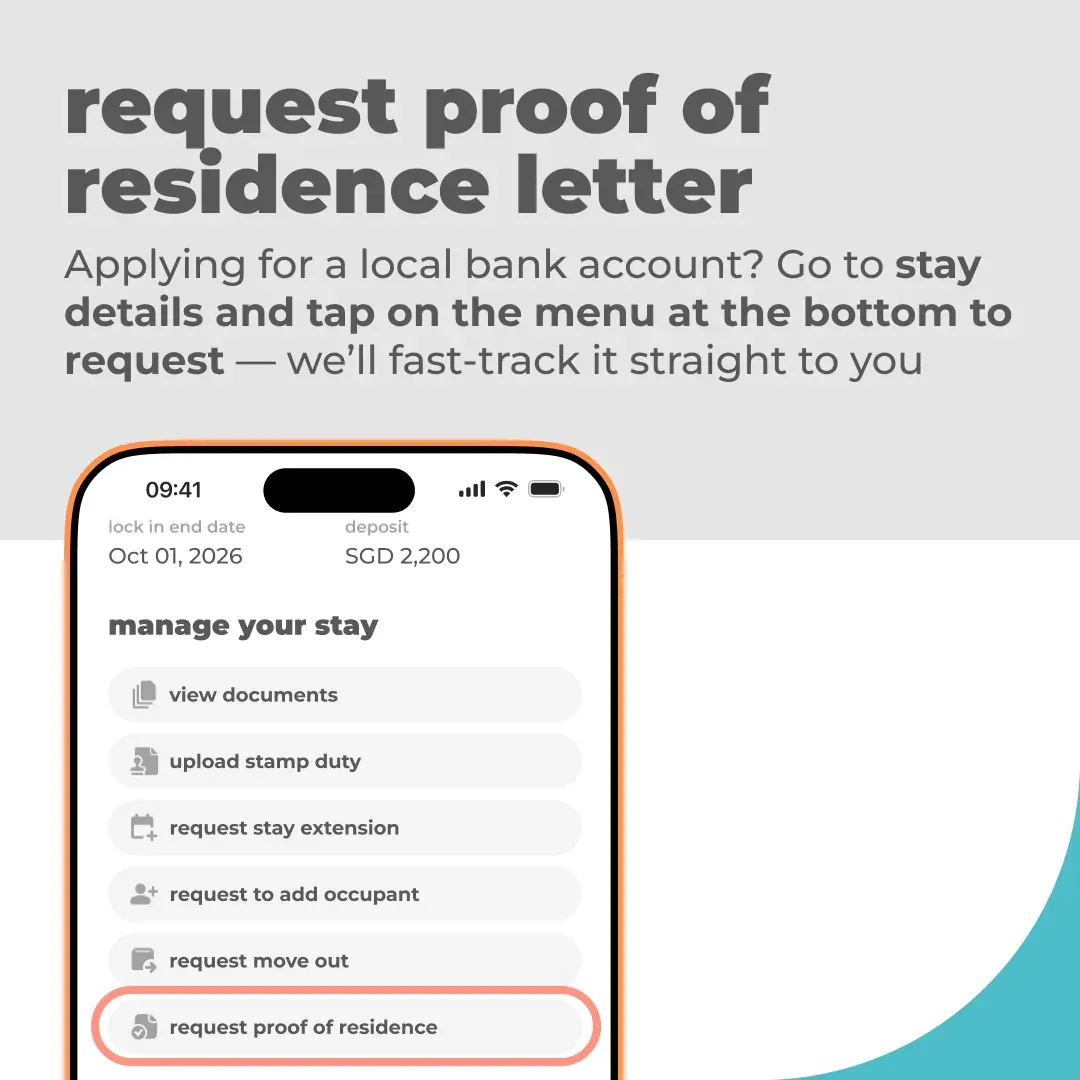
- Request proof of residence: Under Stay Details, tap Request Proof of Residence to receive an official proof of address letter, which is helpful when setting up a local bank account.

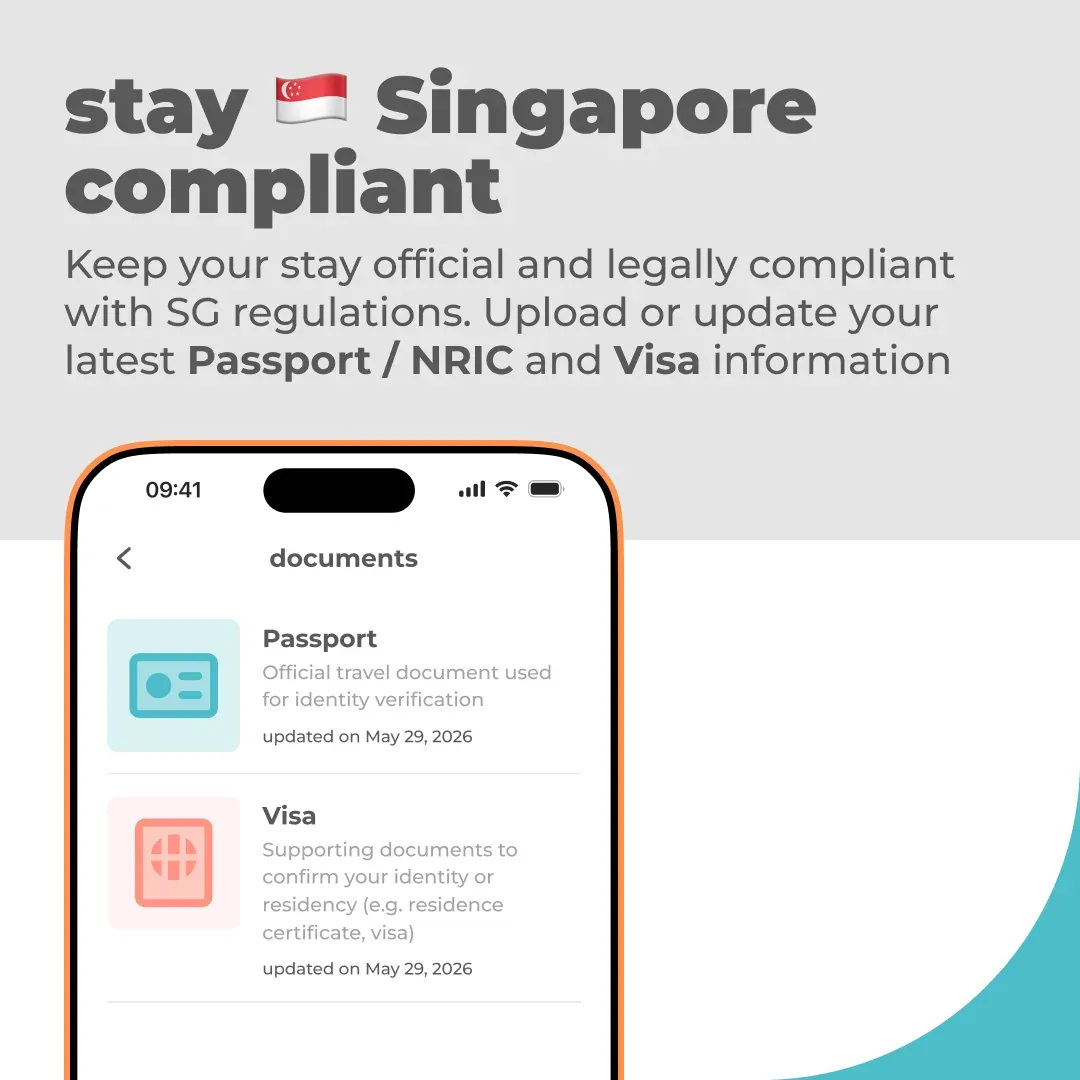
The app also stores key identity documents, such as your Passport, NRIC, or Visa, in one place under the Documents section to keep your tenancy records organized.
Ready to find your next home in Singapore? Explore flexible, fully furnished coliving spaces and apartments with Cove today.