
Is Airbnb Legal in Singapore? Rules, Fines, and Better Alternatives (2026)

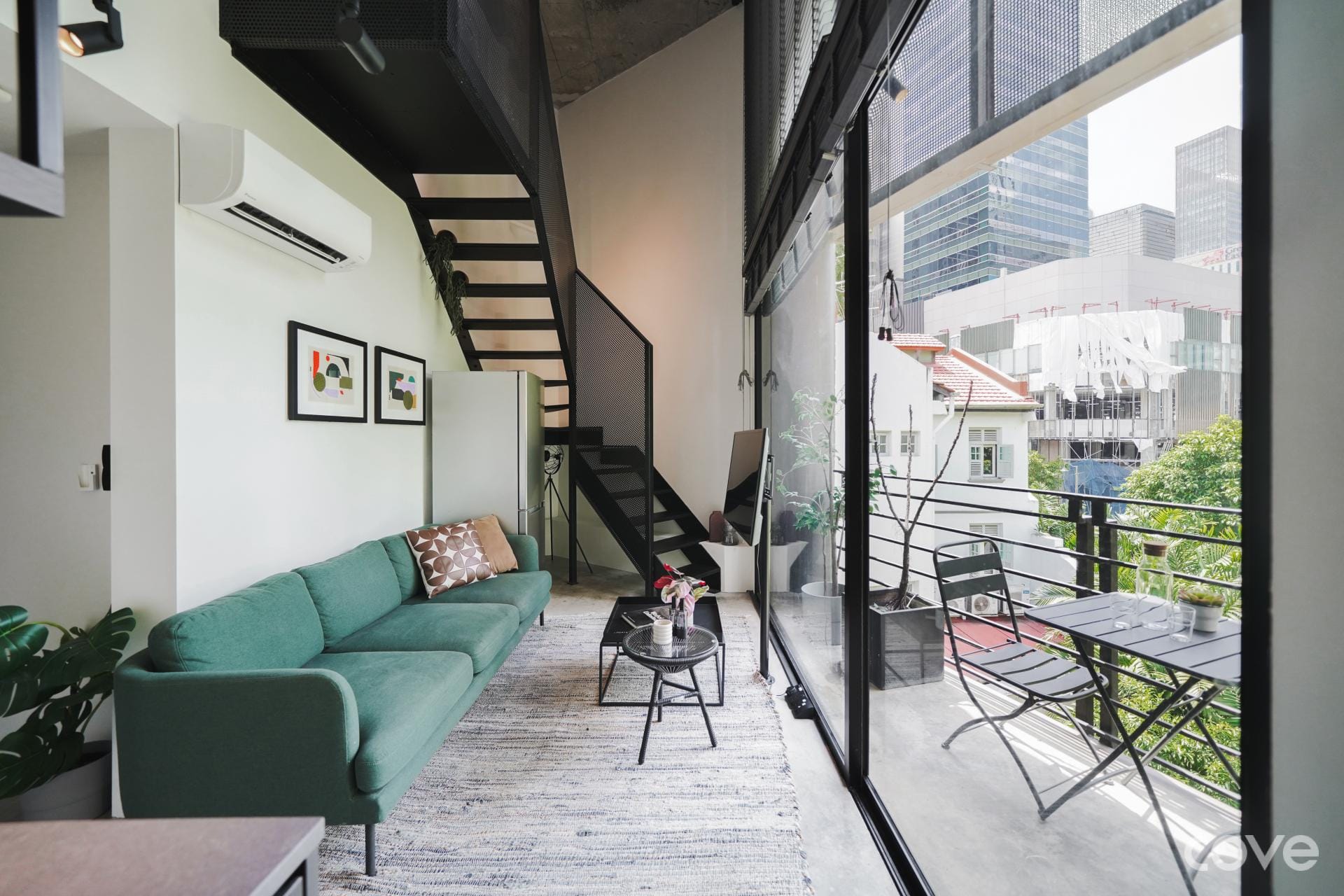
Airbnb as a platform is not banned in Singapore, but the short-term stays it enables are restricted under housing law. Private residential properties like condos and landed houses cannot be rented out for less than 3 consecutive months, as enforced by the Urban Redevelopment Authority (URA) under the Planning Act. HDB flats have an even stricter minimum of 6 months and cannot be rented to tourists at all. This means most Airbnb-style stays of a few days or weeks are illegal for property owners in Singapore. Guests are not penalized, but their stay can be terminated if authorities intervene. For stays shorter than 3 months, legal options include hotels, licensed serviced apartments (minimum 7 days), and coliving operators like Cove that hold serviced apartment licenses allowing stays from 6 nights at select properties, or standard 3-month leases across their wider portfolio. You can browse available rooms and apartments at cove.sg.
Airbnb is an online marketplace where property owners list their homes, apartments, or spare rooms for short-term rental to travelers. Unlike hotels, Airbnb properties are typically private residences managed by individual hosts rather than licensed hospitality operators. This peer-to-peer model has made Airbnb popular worldwide for affordable, home-like stays. However, in Singapore, this model conflicts directly with housing regulations that set minimum rental periods for residential properties.
What are the rules for short-term rentals in Singapore?
Singapore's rental regulations are straightforward but strict. The rules differ depending on the type of property, and they apply whether you are renting an entire unit or just a single room.
Private residential property (condos, landed houses):
- Minimum rental period: 3 consecutive months
- Governed by: URA under the Planning Act
- Applies to both entire units and individual rooms
- The owner must ensure the property is used for long-term residential purposes only.
HDB flats (public housing):
- Minimum rental period: 6 months
- Cannot be rented to tourists under any circumstances
- Only rentable to foreigners with valid passes (Employment Pass, S Pass, Student Pass, Dependent Pass, Long-Term Visit Pass)
- The owner must obtain HDB approval before subletting.
- Owners of 1-room and 2-room flats cannot sublet bedrooms.
Hotels and serviced apartments:
- No minimum stay restriction (commercially licensed)
- Licensed serviced apartments typically require a minimum stay of 7 days.
- A newer category of "long-stay serviced apartments" requires a minimum stay of 3 months.
Source: URA — Short-Term Accommodation
What are the penalties for illegal short-term rentals?
Singapore enforces these rules strictly. The fines are high and have gone up over time.
For private property owners:
- First offense: fine up to SGD 200,000
- Continued offense after conviction: additional SGD 10,000 per day the violation continues
- Repeat offenders: fine up to SGD 200,000 plus imprisonment up to 12 months
For HDB flat owners:
- Fine up to SGD 50,000
- Possible compulsory acquisition of the flat by HDB
For guests:
There are currently no laws penalizing guests who stay in illegal short-term rentals in Singapore. However, guests face real risks. If authorities conduct an inspection and discover the illegal rental, guests may be forced to vacate immediately. Because the rental agreement is not legitimate, there is no legal framework to protect the guest's financial investment. Guests may lose their entire rental payment with no recourse for a refund. There have also been cases where Airbnb guests with confirmed bookings were turned away by building security at the condominium entrance.
In short, guests will not be fined, but booking an illegal short-term rental in Singapore means you risk being evicted suddenly and losing your money.
Legal alternatives to Airbnb in Singapore
If you need accommodation in Singapore and cannot or do not want to commit to a traditional long-term lease, here are your legal options with actual pricing.
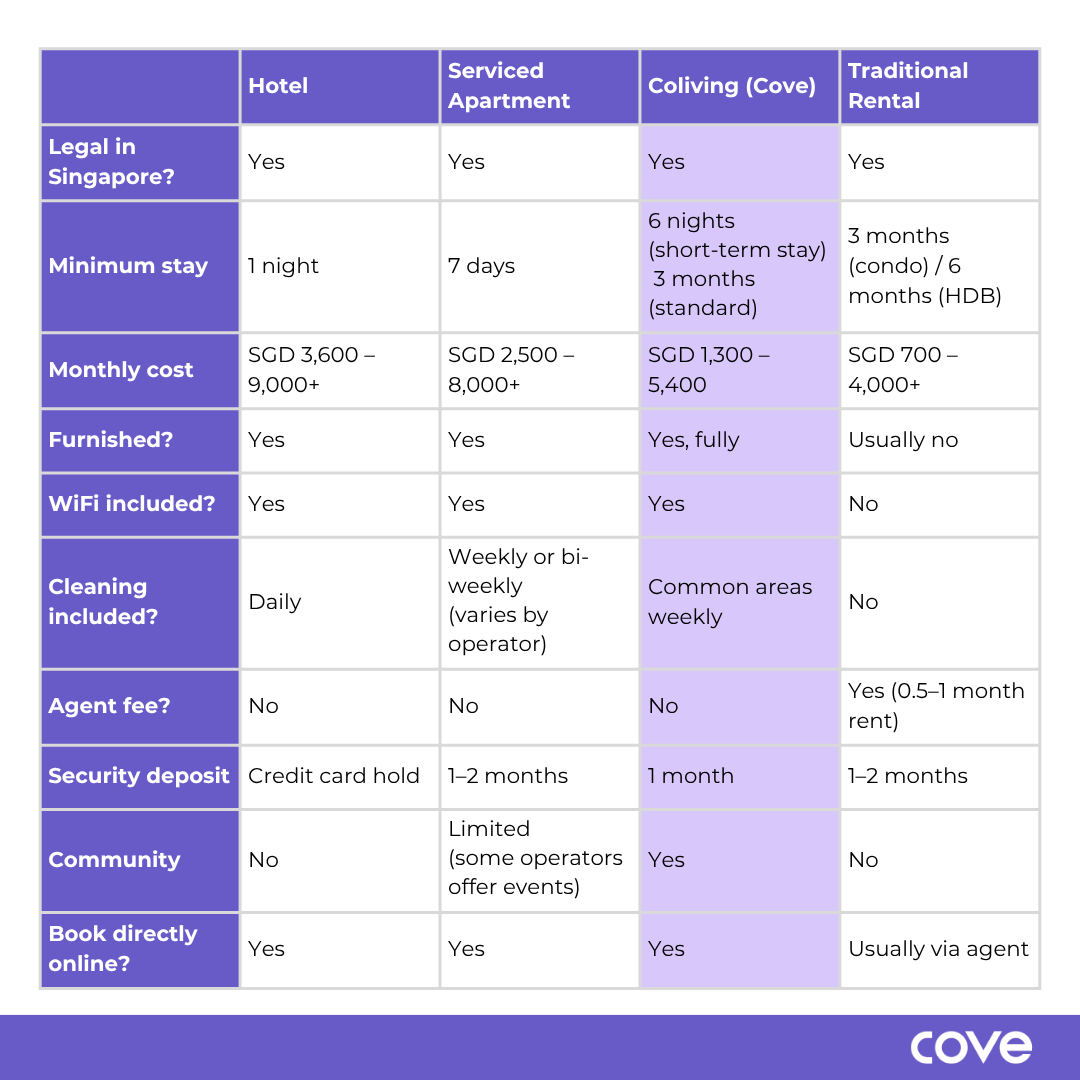
Here is what each option offers and who it works best for:
Hotels
Best for stays under 1 week. Hotels are the most convenient option for short visits, but they become expensive quickly for anything beyond a few nights. Budget hotels in Singapore start around SGD 120 per night, while mid-range options run SGD 200-300 per night. For a full month, that translates to SGD 3,600 at the low end. Hotels are ideal for tourists and business travelers on short trips.
Serviced apartments
Serviced apartments are licensed and offer hotel-like services such as cleaning, concierge, and maintenance, but in apartment-style spaces with kitchens and living rooms. Companies like Ascott, Frasers Hospitality, Far East Hospitality, Oakwood, and MetroResidences run these properties.
Studio apartments start at about SGD 2,500 per month in outer areas, and go from SGD 4,000 to SGD 8,000 in top locations like Orchard and Marina Bay. Most require you to stay for at least 7 days, though some require a 3-month minimum. These are best for business travelers with company budgets and families moving to Singapore for a short time.
Coliving with Cove
Fully furnished rooms and apartments with all bills included in one monthly price. No agent fees, no utility setup, no furniture to buy. Cove operates across Singapore with options ranging from shared coliving rooms (from SGD 1,300/month) to private studios and 1-2 bedroom apartments (up to SGD 5,400/month). Standard leases start at 3 months.
Select Cove properties offer short-term stays from 6 nights for those who need more flexibility. All properties are fully compliant with URA regulations. Best suited for young professionals, expats, digital nomads, and anyone relocating to Singapore who wants a hassle-free living arrangement.Browse available rooms at cove.sg.
Traditional rental (via PropertyGuru, 99.co)
Renting a condo room or HDB room directly from a landlord. This offers the lowest monthly rate, but comes with significant upfront costs: agent fees (0.5-1 month's rent), a security deposit (1-2 months' rent), buying your own furniture, and setting up utilities and WiFi. Most landlords require a 12-24 month lease. Condo rooms can be rented for a minimum of 3 months, and HDB rooms for a minimum of 6 months. Best suited for people who are committed to staying in Singapore long-term and want maximum space at the lowest monthly cost.
How to choose the right option based on your stay
The legality of accommodation in Singapore depends heavily on how long you plan to stay. Here is a simple guide to help you decide:
Staying 1 to 6 nights?
Your legal options are hotels and hostels. Book through Booking.com, Agoda, or directly on the hotel website. Expect to pay SGD 120-300+ per night, depending on the hotel category.
Staying 7 nights to 3 months?
You have two main options: licensed serviced apartments (minimum 7 days) or Cove short-term stays (from 6 nights at select properties). Serviced apartments suit business travelers on corporate budgets. Cove suits professionals and relocating workers who want a home-like setup at a more accessible price point. You cannot legally rent a private condo or HDB flat for this duration.
Staying 3 to 6 months?
This is where coliving with Cove offers the strongest value proposition. Cove's standard 3-month leases give you a fully furnished room without the upfront costs of traditional renting. Serviced apartments also work for this duration, but at a higher monthly rate. Traditional condo rentals become an option at the 3-month mark, but most landlords still prefer longer leases.
Staying 6 months or longer?
All options are available at this duration, including HDB room rentals. Coliving with Cove remains a strong choice for those who value flexibility, convenience, and community. Traditional rentals become more viable for people who want maximum space and are willing to handle the setup costs and landlord relationship. Compare the total cost of traditional renting (rent + agent fee + deposit + furniture + utilities) against Cove's monthly price before deciding.
Is Booking.com the same as Airbnb in Singapore?
Booking.com and Airbnb are both accommodation platforms, but they work quite differently in Singapore's regulatory context.Airbnb primarily lists private residential properties from individual hosts. In Singapore, most of these properties are not legally permitted for short stays (under 3 months for condos, under 6 months for HDB). This means the majority of Airbnb's Singapore inventory operates in a legal grey area.
Booking.com, on the other hand, aggregates mostly commercially licensed inventory: hotels, hostels, and serviced apartments. These are properties that hold the proper licenses to host short-term guests and are fully compliant with Singapore law. However, it is worth noting that Booking.com also lists some private residential properties, so guests should still verify that any non-hotel listing complies with Singapore's minimum stay requirements.
What is the difference between Airbnb and a serviced apartment?
Serviced apartments are commercially licensed properties with hotel-like services (regular cleaning, concierge, maintenance) but in apartment-style layouts that include a kitchen, living area, and often laundry facilities. The key differences from Airbnb in Singapore are:
- Legality: Serviced apartments are fully legal for short stays in Singapore. Airbnb-style rentals in private residential properties are not, unless the stay meets the 3-month minimum.
- Consistency: Serviced apartments are professionally managed with standardized quality. Airbnb quality varies significantly from host to host.
- Services: Serviced apartments include regular cleaning, maintenance, and often concierge services. Airbnb properties are typically self-service.
- Pricing: Serviced apartments in Singapore typically cost SGD 2,500 to SGD 8,000+ per month, depending on location and size. This is generally more expensive than Airbnb was known for, but includes utilities, WiFi, and cleaning.
What might change? URA's evolving regulatory framework
Singapore's approach to short-term rentals is not static. In recent years, URA has signaled a willingness to expand accommodation options:
In 2023, URA announced a pilot program for a new category of serviced apartments with a 3-month minimum stay requirement, expanding the pool of legal medium-term accommodation in Singapore. This was seen as a response to growing demand from relocating professionals and corporate travelers who need flexible stays shorter than a traditional 12-month lease.CNA has reported that URA continues to evaluate the regulatory framework for short-term accommodation, and industry observers expect further adjustments as Singapore balances tourism demand with residential quality of life.
For now, the 3-month minimum for private property and the 6-month minimum for HDB remain firmly in place. Any traveler or renter should plan their accommodation based on the current rules, not on speculation about future changes.
Finding the right place to stay in Singapore
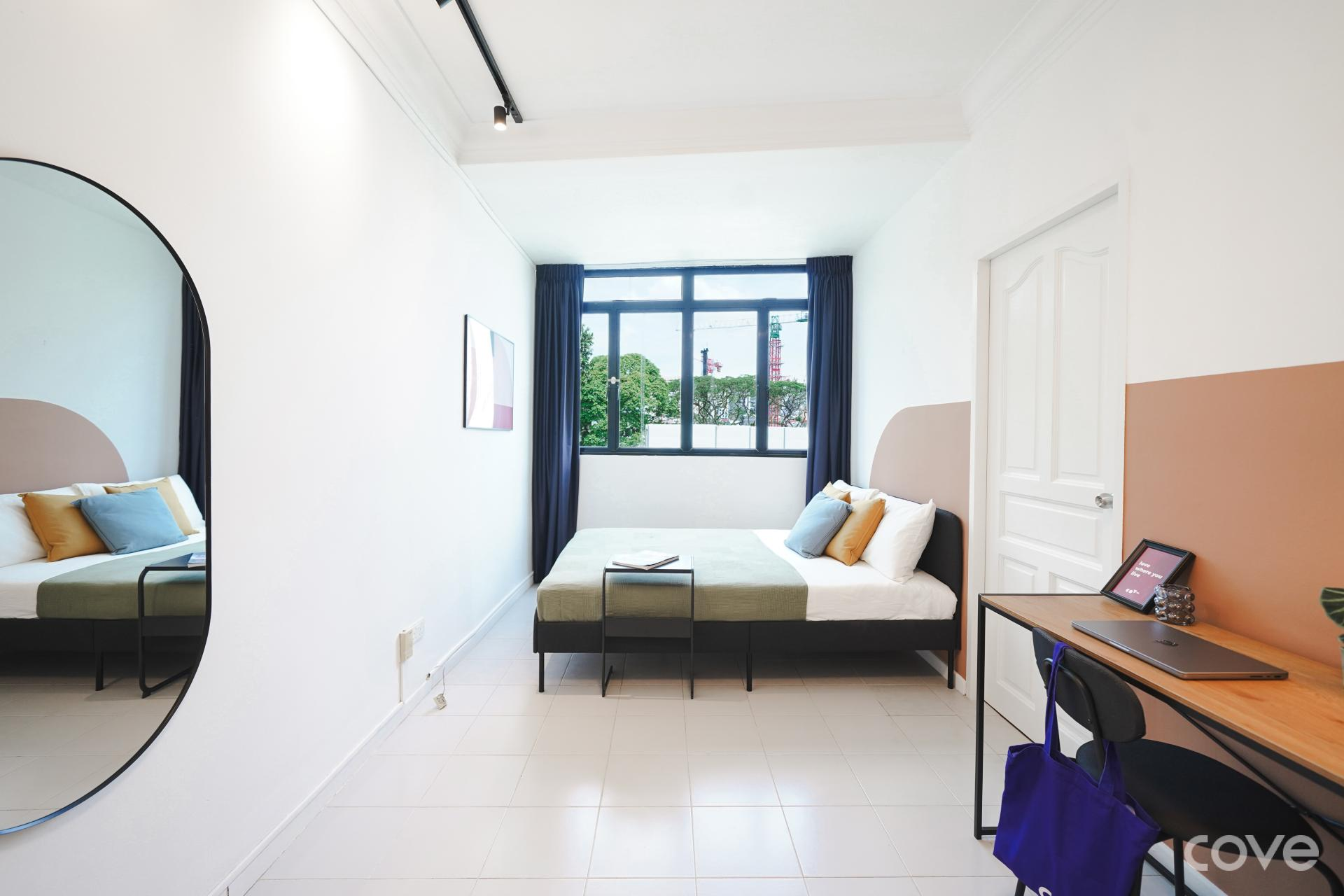
Singapore's short-term rental rules can feel restrictive at first, but the city has a mature ecosystem of legal alternatives that often provide better value, more reliability, and zero legal risk compared to Airbnb.For stays of 6 nights or more, Cove offers fully furnished accommodation across Singapore with no agent fees and no hidden costs. Whether you are relocating for work, between permanent homes, or exploring life in Singapore, Cove provides a hassle-free way to settle in. Visit cove.sg to browse available rooms and apartments.
Pricing in this article is based on publicly available data and may vary. Hotel rates sourced from Booking.com average. Serviced apartment ranges based on Honeycombers 2026 guide. Cove pricing is based on published tier rates. Traditional rental ranges based on Casa Mia / Cove blog market data. Minimum stay rules per URA (ura.gov.sg). Always verify current pricing directly with the provider.